
Agentic AI Security: 6-Layer Defense Model for Coding Agents
Agentic AI systems are no longer a concept—they’re live in production. Investors need to see past the hype: these platforms promise automation, but they add novel risks. When an agent can call APIs, run shell commands or manage cloud resources, a simple prompt slip can lead to real damage. That shifts threats from bad text to operational breaches that cost time, money and reputation. You need a clear defense model to stay ahead.
The evolution from stateless chatbots to agentic workflows is driving this shift. Early assistants only answered queries, so mistakes stayed in text. Now agents plan multi-step tasks, fetch documents, write code and trigger actions across systems. That extra autonomy widens the attack surface—new tool paths, memory stores and APIs all become targets. Development teams face a security puzzle that traditional LLM safety methods can’t solve.
Distinct Threat Class
The same prompt injection that once produced wrong answers now can delete files or exfiltrate secrets. Researchers at NIST’s Center for AI Standards report red-team success rates above 80% against baseline agent setups. This isn’t confined to one platform—it’s a systemic weakness whenever models gain execution privileges. For investors, that spells two things: growth in demand for secure agentic frameworks, and risk to deployments that skip proper controls.
Six Architectural Layers
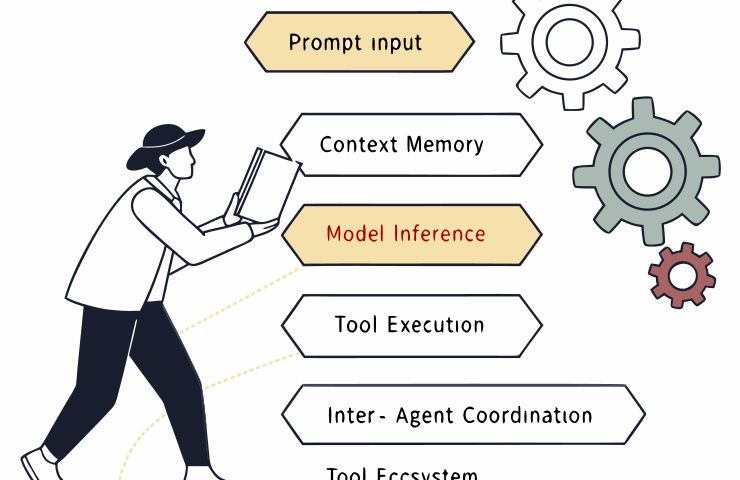
A robust security posture starts with a clear map of where attacks can land. The guide identifies six layers—prompt input, context and memory, model inference, tool execution, inter-agent coordination and the surrounding tool ecosystem. Each layer acts as a trust boundary where untrusted data can transform into high-impact commands. A breach at any boundary can escalate from annoyance to operational failure.
Prompt/Input: Direct user or API calls sit at the front door. Prompt injection remains a killer app for attackers—slip in a malicious instruction and many agents will follow it. OWASP’s LLM Top 10 ranks prompt injection as a top threat. That applies even more in agentic setups because injected text can translate into system commands. Effective input filters and policy validation before the model sees data are table stakes.
Context/Memory: Agents ingest documents, chat history and past results into a vector store or memory buffer. That memory layer is ripe for indirect prompt injection. In the EchoLeak case (CVE-2025-32711), a crafted email reportedly tricked an agent into exfiltrating files. To block indirect attacks, retrieval pipelines need strict access control and content validation. Treat every piece of memory as untrusted until policy checks clear it.
Model Inference: The LLM itself can harbor hidden weaknesses. Backdoor triggers or misalignment bugs may react to adversarial patterns in unexpected ways. NIST’s AgentDojo research shows how simple red-team methods can subvert inference. Regular auditing, alignment testing and fine-tuning reviews are essential. You must catch inference-level failures before they translate into bad reasoning or harmful tool calls downstream.
Tool Execution: This layer bridges model outputs and real-world actions—API calls, shell scripts, database transactions. Without granular controls, a malicious instruction can wreak havoc. Reports point to very high unsafe behavior rates in default agent configurations. Sandboxing execution environments, issuing scoped tokens and allowlisting commands shrink the blast radius. Every attempted action must pass a policy check before it runs.
Inter-Agent Coordination: Complex tasks often spawn multiple agents that coordinate by exchanging messages. That expands scale but also multiplies trust assumptions. A compromised agent can inject commands that cascade through the network—a phenomenon dubbed the Trust–Vulnerability Paradox. You need cross-agent authentication, message validation and rate limits to contain a rogue actor before it infects the rest.
Tool Ecosystem: Agents tap into external libraries, plug-ins and skill marketplaces to extend capabilities. Those third-party components can become supply-chain threats if compromised. The MITRE OpenClaw investigation shows how vendor marketplaces can slip in malicious packages. Code signing, vulnerability scanning and rigorous vendor vetting are critical. Treat every imported skill as untrusted until it passes security reviews.
Common Design Patterns
Architectural choices shape risk. Popular motifs include ReAct loops, plan-and-execute flows, retrieval-augmented generation (RAG) pipelines, reflection steps and multi-agent frameworks. Each pattern pushes data across our six layers in its own way. Mapping these patterns to threat types helps teams tailor defenses to their specific agentic workflows.
ReAct & Plan-and-Execute: ReAct combines reasoning and actions in a single loop. That dynamic handoff needs strict checks on every iteration—tool outputs must be sanitized so they don’t re-enter the reasoning prompt with malicious content. Plan-and-execute separates planning from action. It simplifies execution but offers an opening for plan poisoning, where attackers slip harmful steps into the generated plan. Validation at both planning and execution stages is vital.
RAG & Multi-Agent: RAG systems pull external data into the context window, which exposes them to PoisonedRAG attacks that plant malicious documents in a corpus. When you layer on multi-agent orchestration, these poisoned goals can propagate rapidly. Defenses include retrieval-time access control, corpus integrity checks and per-agent identity verification—ensuring that data stays clean and agents only act on validated sources.
Defense in Depth
No single control suffices. You need defense in depth—multiple, overlapping layers of protection. That means combining infrastructure-level controls, prompt and content guards, execution restrictions, human approval steps and real-time monitoring. This layered approach converts isolated failures into manageable events rather than catastrophic breaches.
Infrastructure & Input Controls: Start by treating each agent as a zero-trust identity. Assign minimal IAM roles, segment networks and enforce least privilege. At the same time, sanitize all inputs—user prompts, retrieved documents and memory entries. Implement access control and policy checks in your retrieval pipeline to catch suspicious content before it ever reaches the model.
Execution & Human-in-the-Loop: Sandbox every tool call and issue short-lived, scoped tokens for APIs and shells. Use allowlists for permitted commands. For high-risk actions like data deletion or fund transfers, require human approval. This balance preserves autonomy for low-risk tasks while ensuring oversight on critical operations.
Observability & Monitoring: Stream structured events from your agent to a security dashboard. Track each reasoning step, tool invocation and memory update. Set circuit breakers that kill sessions on anomalous patterns. Real-time monitoring gives you a chance to intervene and contain issues before they spread.
Cosmos in Action
Cosmos from Augment Code unifies these controls into a single platform for coding agents. It wraps agents in governed environments, policy-driven skill registries and shared memory with audit trails. You deploy agents with explicit boundaries on data, tools and permissions—no custom scripts required. Cosmos also delivers out-of-the-box observability, so you get immediate visibility into every agent workflow and can detect anomalies as they happen.
Sessions in Cosmos record every prompt, tool call and memory change as a structured event. These sessions form a replayable audit trail you can query or feed into anomaly detection engines. That consistency removes guesswork from incident response and simplifies compliance reporting, since you can show regulators exactly how an agent reached any decision.
Implications for Investors
Demand for secure agentic platforms is heating up. Enterprises deploying autonomous agents will pay premiums for built-in security and governance. We expect budgets to shift toward vendors that bake defense in depth into their core products, rather than bolting on tools after the fact. Regulatory pressure is mounting. Bodies like NIST and alliances like the Cloud Security Alliance are setting standards for agentic AI. Vendors that can demonstrate compliance will unlock broader market access. We see ripe opportunities for startups specializing in policy engines, observability solutions and zero-trust identity management for agents. In this market, securing trust boundaries is a clear differentiator that investors should watch closely.
Risks & Watchpoints
Over-relying on prompt restrictions is a danger—models can ignore or misinterpret system instructions under adversarial conditions. Supply-chain threats hide in third-party skills and libraries; code signing and continuous vetting are essential. Persisted memory stores can harbor hidden commands, making PoisonedRAG attacks a long-tail risk. A solid security posture treats every data pipeline as untrusted until validated, and monitors agent behavior for signs of compromise.
Takeaways
Agentic AI creates a distinct threat class that demands defense in depth. Explicit trust boundaries across prompts, data, inference and execution are non-negotiable. Platforms like Cosmos illustrate how governance, sandboxing and observability tie together to safeguard workflows. For investors, the best bets lie with companies turning security into a core value proposition—those will lead the market as agentic adoption accelerates.