
AI Infographic Generation: Comparing Claude Design, NotebookLM and ChatGPT
Context
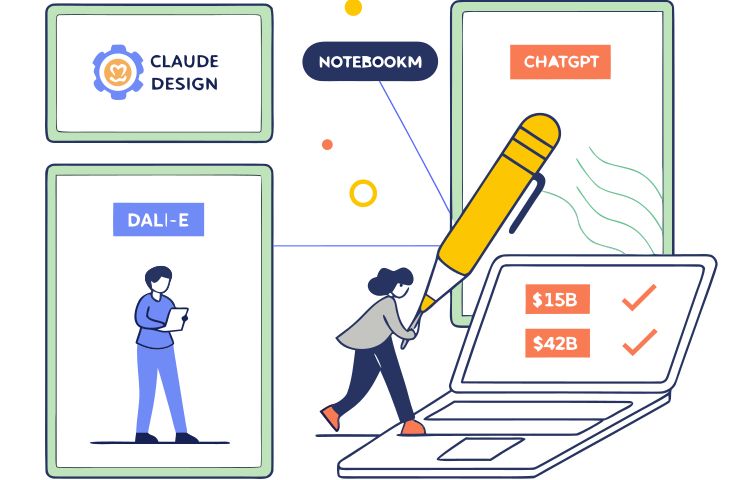
The AI design tools market is on a steep growth curve, rising from roughly $15.1 billion in 2024 to an expected $42.5 billion by 2033 at a 12.5 percent CAGR. Investors want clarity on which platforms deliver real-world value in infographic and slide creation. Three contenders—Claude Design from Anthropic, Google’s NotebookLM, and ChatGPT with integrated DALL-E 3—offer distinct approaches. This analysis cuts through hype and highlights where each tool stands on prompt fidelity, text accuracy and enterprise readiness.
Anthropic’s Claude Design: Precision First
Anthropic has grown rapidly since 2021 to a $380 billion valuation and about $14 billion in annualized revenue. It built Claude Design on top of its Claude Opus 4.7 multimodal engine. The selling point: pixel-perfect adherence to prompts and clean, legible text in infographics. Early diffusion models struggled with gibberish labels—Claude Design targets that with a reasoning-first vision stack that ingests images up to 2,576 pixels. Users draft a conversational description, then refine with sliders or follow-up instructions. The output exports directly to Canva, PDF or PPTX with minimal post-edit effort.
In a recent hands-on test highlighted by MakeUseOf, Claude Design reproduced data tables and axis labels accurately, even under complex layouts. According to sources, long text strings stayed intact more often than competing tools. The company indicates this capability rests on upgrades to its encoder architecture, which combines visual and language signals to enforce semantic consistency.
From an investor perspective, reliability in text rendering translates to less manual cleanup and faster turnaround. Enterprises building dashboards, investor decks or marketing materials can save hours per project. If Anthropic maintains alignment between models and user needs, Claude Design could capture a disproportionate share of the pro design segment.
Google’s NotebookLM: Grounding Over Creativity
NotebookLM started as an experimental AI research assistant. It taps Google’s Gemini backbone and a retrieval-augmented generation (RAG) layer that pulls directly from user-uploaded documents. In late 2025, Google rolled out an image-generation feature powered by its Nano Banana Pro model. The emphasis here is on source-grounded visuals—tables, charts and annotated diagrams that reflect your own data, not an AI’s best guess.
For teams that rely on research reports, white papers or internal slide decks, NotebookLM cites the exact snippet used to build each infographic element. That cuts hallucination risk to near zero. Users upload PDFs, documents or web links, then prompt the assistant for a summary slide or a custom infographic. The AI stitches text and visuals with inline citations, making compliance and audit trails straightforward.
One downside: creative flexibility remains limited compared to tools optimized for open-ended design. You won’t get highly stylized layouts out of the box. But if your priority is accuracy and traceability, NotebookLM reduces review cycles and legal exposure. For R&D labs and regulated industries, that can outweigh the lack of fancy templates.
ChatGPT with DALL-E 3: Versatile but Imperfect
OpenAI sparked the generative AI wave with ChatGPT in 2022 and layered in DALL-E 3 for image gen shortly after. Its strength lies in conversational flexibility—you can brainstorm layout ideas and iterate prompts in real time. With GPT-5.5 in 2026, the model improved its ability to interpret user sketches and contextual cues.
However, diffusion-based pipelines still struggle with text rendering. Independent benchmarks put long string accuracy below 90 percent. That means axis labels, data call-outs or detailed legends often need manual correction. In fast-moving creative sessions, you trade off fidelity for exploratory speed. Teams using ChatGPT images typically extract concept sketches, then shift to a dedicated design tool for polish.
For startups and small agencies, having one platform that handles both text prompts and image outputs can streamline workflow. But the need for cleanup adds hidden labor. Investors should weigh ChatGPT’s broad utility against potential downstream costs in editing and compliance.
Key Takeaways for Investors
Prompt fidelity matters more than ever. If your portfolio includes SaaS or enterprise design plays, note that text accuracy moves deals forward. Claude Design leads on that axis, reducing manual rework and improving time-to-market for professional decks and infographics. Its backing from a company with $14 billion in run rate revenue suggests ample runway for further vision improvements.
NotebookLM addresses a different need. Grounded outputs and source citations align with compliance requirements in finance, healthcare and government. That niche can sustain premium pricing and lock-in if Google continues to enhance RAG performance.
ChatGPT remains the go-to for ideation. Its integration of conversational AI and image gen is unmatched in breadth. But investors should be cautious about underestimating cleanup costs, especially for data-heavy visuals.
Risks and Watch Points
Energy consumption is a wild card. Daily use of high-res models ramps up compute costs and carbon footprints. Efficiency gains will be key to sustain margin pressures. Keep an eye on any new encoder optimizations or hardware partnerships.
Regulation may tighten. The EU AI Act and IP debates over training data could slow feature rollouts or impose royalties. Tools that offer provenance and citation—like NotebookLM—may face fewer headwinds.
Finally, market share battles are intensifying. Anthropic has the reliability edge, but Google and OpenAI control massive distribution channels. Strategic partnerships and integrations—whether into Microsoft Office, Google Workspace or design platforms—will decide who owns the user’s next slide deck.
Implications for Your Portfolio
Expect consolidation in the design-AI space. Companies that nail text accuracy and grounding will command premium valuations. Others will need to bulk up via acquisitions or platform tie-ins. If you’re evaluating exposure to GenAI, weigh pure-play design tools against broader LLM providers. The former may offer steadier revenue via enterprise contracts; the latter carry higher growth upside but more volatility.
In short: prioritize precision where it counts, grounding where it matters, and versatility where it pays. Your choice sets the tone for productivity gains or hidden frictions in the next wave of AI-powered design.