
Exploring the Rise of Prompt Engineering: Tools, Trends, and Market Growth
I still remember the first time I saw a generative AI model respond to one of my prompts. It was a simple request—summarize my weekend in a poetic style—but the answer surprised me with just the right mix of clarity and creativity. That night, I found myself in coffee-fuelled euphoria, swapping out single words, adding guiding instructions, and experimenting with temperature settings, convinced that each tweak would unlock the perfect response. Before long, I had a dog-eared notebook filled with prompt experiments, debugging sessions, and even charts tracking how the model’s replies varied when I changed punctuation. On a sleepless December evening, I cracked a chain-of-thought prompt that made the AI break down multi-step reasoning as if guiding a friend through a puzzle. In that moment, I felt unstoppable.
Like many, I turned to prompt engineering after reading about how small changes could drastically alter outputs from models like GPT-3. What began as a late-night hobby soon became an obsession during tough times. When I was nursing a broken heart after a rough breakup, I dove into crafting prompts that helped me organize my thoughts and draft apology letters. In college, while everyone else slept at 4 AM, I was comparing n-shot examples and debating which few-shot technique would yield the best summary for my research paper. Even on vacations, I'd clutch my laptop, sketching prompt chains on napkins at beachside cafes. Some might call this unhealthy, but for me it was a source of endless fascination and comfort.
Even when I wasn’t actively prompting, my subconscious worked on it. I’d wake up with lines of text in my head, pacing my apartment reciting different phrasings. During a long drive, I’d brainstorm how a few extra example prompts might improve a summary my team needed for a product pitch. That compulsion once led me to pause mid-order at a drive-thru just to tweak a prompt so the AI would format my grocery list more neatly. Sure, some days it felt like madness, but when that perfect reply landed, it was pure joy.
Market Growth and Projections
It wasn’t just hobbyists who recognized the value of prompt engineering. According to The Business Research Company, the global prompt engineering market is projected to grow from $0.85 billion in 2024 to $1.13 billion in 2025 and reach $3.48 billion by 2029, implying a compound annual growth rate of around 32.4%. This surge reflects real business needs: enterprises aiming to fine-tune AI for customer service, content creation, software development assistance, and more require systematic workflows to design, test, and optimize prompts. The rapid expansion signals that prompt engineering is moving from a niche craft to a strategic capability.
The report also highlights digitalization as a long-term driver. For example, growing investment in digital infrastructure in the United Kingdom—and similar efforts worldwide—expands access to online processes and rich datasets. These developments give organizations the foundation they need to implement large-scale prompt engineering workflows and integrate AI more deeply into their operations.
Regional dynamics further illustrate this trend. The Business Research Company reports that North America was the largest market in 2024, while Asia-Pacific is expected to be the fastest-growing region over the forecast period. That means established tech hubs will continue leading adoption even as new markets embrace AI-driven innovation.
Innovation in Platforms and Tools
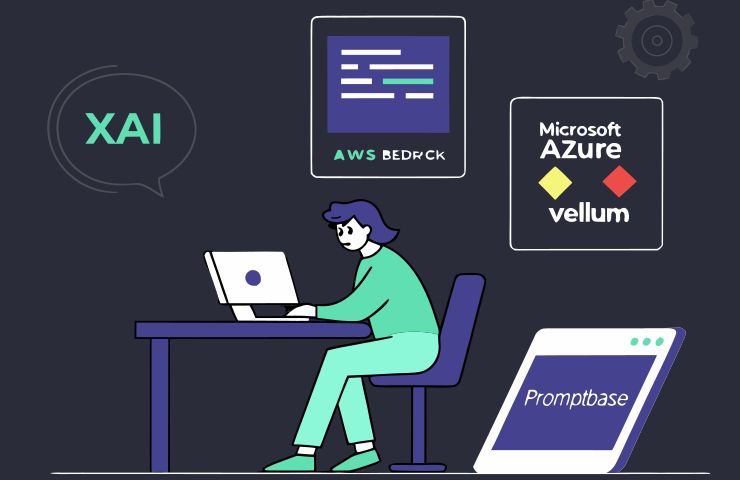
Prompt engineering is no longer a free-form text box experiment. Vendors are building specialized environments with features that treat prompts like code. xAI’s PromptIDE provides a Python-based editor, software development kit, auto-saving, version control, and detailed analytics such as token-level probability breakdowns. This setup lets engineers iterate on complex prompts and inspect exactly how each word influences the output.
Independent tooling roundups frequently list platforms like Braintrust, PromptHub, and Galileo alongside Vellum. These environments offer features such as prompt versioning, regression testing against curated test suites, and observability dashboards that monitor prompt performance in production. By treating prompts as first-class artifacts, these tools help teams collaborate on prompt libraries and enforce governance the same way they would on code bases.
Hyperscale providers have also stepped in. Microsoft incorporates configurable prompt templates and orchestration into its Azure AI Foundry and Copilot services, enabling teams to manage prompt libraries and automate testing at scale. Amazon Web Services offers similar capabilities through Amazon Bedrock, where users can configure prompts, run controlled experiments, and integrate evaluation workflows. Meanwhile, model specialists like OpenAI and Anthropic shape prompt best practices via their APIs and playground interfaces. Niche players such as Vellum focus on visual agent workflows and production deployment, and marketplaces like PromptBase let prompt creators monetize templates. Together, these competitors represent an ecosystem that ranges from cloud giants to boutique tooling vendors.
Segmentation and Key Drivers
The market report breaks down the prompt engineering landscape by component, technique, deployment, application, and industry:
- Software Platforms: prompt development environments, analytics dashboards, and marketplaces.
- Professional Services: consulting, training workshops, and managed prompt engineering engagements.
- Techniques: n-shot prompting, generated knowledge prompting, chain-of-thought prompting, prompt chaining.
- Deployment: on-premises, cloud-based, hybrid environments.
- Applications: content creation, conversational AI, recommendation systems, developer assistants.
- Industry Verticals: healthcare, banking and financial services, insurance, automotive, media and entertainment, retail, IT and telecom.
Key growth drivers include rising enterprise AI adoption, the push for customized model outputs, and broader digitalization efforts that expand access to rich datasets and automated workflows.
A Historical Perspective
Prompt engineering emerged in earnest after large language models like GPT-3 demonstrated that careful prompt design could dramatically improve output quality. Early community posts shared ad hoc tips, but without repeatable processes. Over time, practitioners developed standardized techniques such as few-shot examples and prompt chaining. By the mid-2020s, demand for consistency and governance led to systematic practices: version control, regression testing, and observability dashboards became common tools. This evolution mirrors previous shifts in software development—from informal DevOps scripts to enterprise-grade platforms, and from one-off A/B tests to specialized analytics suites.
Alongside platforms, community-driven prompt libraries emerged, where enthusiasts shared templates for common use cases. Early on, Git repos and gist collections became de facto repositories, and soon dedicated marketplaces like PromptHero and PromptLeo appeared. These repositories accelerated learning curves and offered starting points for teams, reducing time-to-value when onboarding prompt engineering practices.
The structured segmentation by The Business Research Company codifies what had been informal know-how into a clear market definition, complete with software and service offerings, documented techniques, and defined application areas. Specialized platforms like xAI PromptIDE and observability tools signal that prompt engineering is now a distinct product category rather than a side effect of AI access.
Impact and Future Outlook
The formalization of prompt engineering has broad implications. Economically, it adds a new layer of software and service offerings in the AI value chain, influencing how enterprises allocate budgets between model access, data infrastructure, and application tooling. Technologically, dedicated platforms accelerate best practices for prompt design, testing, and monitoring, and push model providers to expose deeper interpretability features.
Prompt marketplaces raise questions around intellectual property, quality control, and compliance with model use policies. Organizations will need standards to vet third-party prompts and ensure they align with brand voice and regulatory requirements. Internally, job titles like “prompt engineer” are popping up, and cross-functional teams that include data scientists, UX designers, and domain experts are collaborating to craft prompts that meet both technical and business criteria.
From a governance standpoint, prompts often embed business logic and safety policies. As regulators focus on AI transparency and risk management, organizations will need auditable prompt catalogs and test records. Tools that record prompt changes, parameter settings, and evaluation metrics will become essential for compliance.
Environmentally, more efficient prompts could reduce compute and energy per inference, even as overall usage grows. Organizationally, we’re likely to see formal roles like “prompt engineer” and internal standards for prompt governance, akin to coding and data management practices. As prompt engineering matures, it will reshape not only how AI systems are built but also how teams are structured and how budgets are assigned.
PromptLab is an AI execution and orchestration layer that sits between your applications and multiple AI model providers, enabling you to run, manage, and optimize prompts at scale through a unified interface and API. It standardizes inputs and outputs across models, provides cost tracking and intelligence, and allows for advanced workflows such as multi-model execution, structured parsing, and agent-based operations. Designed for both experimentation and production use, it gives teams full control over how AI is integrated into their systems while ensuring performance, visibility, and scalability. Learn more about PromptLab.