
The shift from Prompts to clusters
Real applications are rarely one prompt. They plan → search → draft → synthesize, they fan out across items, they combine models. Flows let you build that entire pipeline as a first-class, versioned asset instead of gluing prompts together in application code.
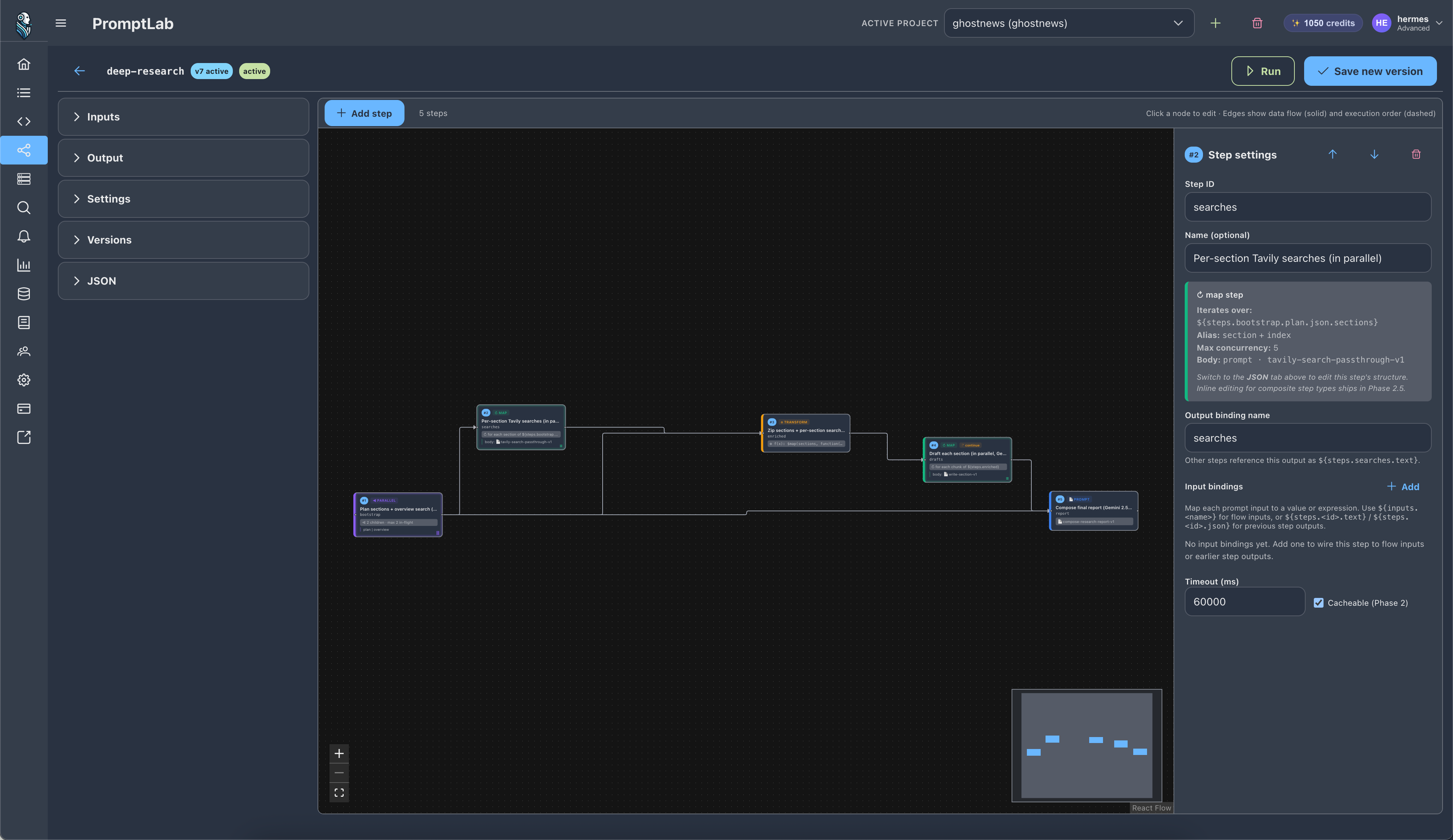
Compose visually or in JSON. Drag steps onto a canvas, connect them, and see the data flow — or edit the spec directly. Both views stay in sync.
Four step types, real orchestration. prompt (call a model), parallel (run steps concurrently), map (fan out over a list), transform (reshape data between steps) — enough to express plan-and-execute, retrieval, fan-out/fan-in, and multi-model synthesis.
Wire outputs to inputs. Bind any step's result into a later step with simple ${steps.x.json} expressions. No plumbing code.
Run once, get one result. Kick off a Flow and poll a single job; the engine handles concurrency, ordering, retries, and assembling the final output.
Why it makes your prompt engineering better
Flows are a first-class, versioned asset — not code drift.
Every Flow has declared inputs and a declared output structure (text or JSON), just like a prompt. Save a change and you get a new version you can activate or roll back instantly. Your pipeline stops living in scattered application code and becomes something you can review, diff, and govern.
Prototype and production are the same artifact.
The Flow you design in the editor is the Flow your app runs through the router — no rewrite, no translation layer. Iterate in the UI, ship without touching the backend.
Reliability is inherited, not rebuilt.
Because each step runs through the PromptLab router, Flows automatically get multi-provider execution, model fallback chains, and JSON-structure enforcement — including for media steps. A stricter primary model that fails or times out falls through to a permissive fallback, without a line of your code.
Faster iteration, cleaner experiments.
Change one step, version the Flow, compare runs. Tune a sub-prompt without redeploying the app. Swap or add a model in a step and measure the difference — the same discipline you apply to single prompts, now applied to whole pipelines.
Why it benefits your applications
Ship complex AI features faster — research assistants, structured-extraction pipelines, multi-model content generation — as a single configured Flow instead of bespoke orchestration code.
Own the reliability layer. Fallbacks, retries, and structured-output guarantees live in the platform, so your services stay thin and your uptime doesn't depend on a single model or provider.
Observe and control everything. Versioning, per-step runs, cost and timing, and a stable job to poll — the visibility you need to run AI in production.